


Absolutely Fabulous: Inside Out
GOLD
★★★★
Absolutely Fabulous: Inside Out review – when Jennifer Saunders and Joanna Lumley cackle, it’s sheer joy

This retrospective on how Jennifer Saunders’s sitcom went from shambles to all-time great has a national treasure gravitas to it – and the juicy anecdotes make the show sing.
There is something very Eddy and Patsy about Absolutely Fabulous getting an in-depth, bells-and-whistles retrospective, not for its 25th or even 30th anniversaries, but for its … 32nd. Absolutely Fabulous: Inside Out is an indulgent treat for fans, bulging out of its Lacroix sample sizes with gossip, memories, outtakes and a warm, if too brief, cast reunion. If, like many of the talking heads here, you believe it to be one of the greatest British sitcoms of all time – and it is, obviously, particularly the first three series – then this is a fantastic and revelatory deep dive into who and what made it so special.
As regular listeners of the French and Saunders podcast Titting About will know, Dawn French took some time away from their double act in the early 1990s to raise her daughter, leaving Jennifer Saunders without her comedy partner and in need of a new project. Saunders admits that at that point, her writing experience had been limited to sketches. But one of those sketches, Modern Mother and Daughter, saw French playing a Saffy character, and Saunders the mother, then called Adriana. You can see how much of the show is there already. It only needed the addition of best friend and fashion editor Patsy – whom Joanna Lumley poetically refers to as a “succubus … like ivy, or one of those insects that feed off you” – to flesh it out. If a single sketch could be nine minutes long, Saunders reasons, you only needed to put two of them together to call it a sitcom.
There’s a lovely against-the-odds narrative throughout. Saunders’ approach to writing Ab Fab appears to have been, shall we say, scattergun, and that was on a good day. The first series was largely written in advance, but later episodes would be worked out in the rehearsal room, with a lot of cigarettes (“We liked all the smoking,” says Lumley). Ruby Wax, who script edited, remembers one script that, in lieu of a written scene, simply said “something funny happens”. To Saunders’ credit, it did. It was so slapdash that Lumley admits she asked her agent to try to get her out of playing Patsy, who said that she should film the pilot anyway, and that it probably wouldn’t take off. Producer Jon Plowman remembers former head of comedy at the BBC, Robin Nash, sitting through the dress rehearsal for the pilot and noting afterwards that he never had found women being drunk very funny.
But plenty of viewers did, and it was a smash hit: the sort of crowd-pleasing comedy, as the director Emerald Fennell says, that only comes along once every decade. To watch it now, for the hundredth time, is to be reminded of how fantastically anarchic it is. The jokes still have fangs, and, to its credit, this doesn’t retrospectively clutch its pearls at some of the more outrageous ones: Patsy telling Saffy that she should have been aborted remains one of its most quotable and most vicious moments. Lumley says she asked if she really had to say the line, and Saunders, of course, insisted she did. This is a timely reminder, too, that as Patsy, Lumley puts in one of the greatest physical comedy turns in TV history, and she still doesn’t get nearly enough credit for how perfect a performance it is. Patsy simply eating is so funny that the cast can’t even talk about it now without cracking up.
Kirsty Young narrates, Saunders unearths her original notes, and it parades costumes from the archives, all of which give the documentary a national treasure-style gravitas. But what really makes it sing are the anecdotes, as unfiltered as Patsy’s liver. Wax talks about the inspiration for Edina, long rumoured to be the one-time PR guru Lynne Franks. The story she tells about sharing a taxi with Franks, and how that led to at least one part of Eddy’s character, is exquisite. Saunders, meanwhile, reveals another, more niche inspiration: Adriana Ivancich, the Italian noblewoman and teenage inspiration for Hemingway’s 1950 novel Across the River and Into the Trees.
June Whitfield, who played Mother, died in 2018; the last time the cast all got together was at her memorial. Jane Horrocks joins Julia Sawalha, Saunders and Lumley for a glass of Bolli, as they look over old Polaroids, watch outtakes and discuss which scenes they couldn’t get through because they were all laughing too much. It might sound luvvie, but it avoids that by sheer force of being so frank and entertaining. And above all, you get to see Saunders and Lumley watching old footage and laughing their heads off. “It was amazing, what we got to do, and it’s just a little comedy, and I loved it,” says Saunders. Delicious.

Blackadder, the Lost Pilot
UKTV Channel Gold
★★★★
Blackadder, the Lost Pilot, review: Tony Robinson affectionately introduces the birth of a classic
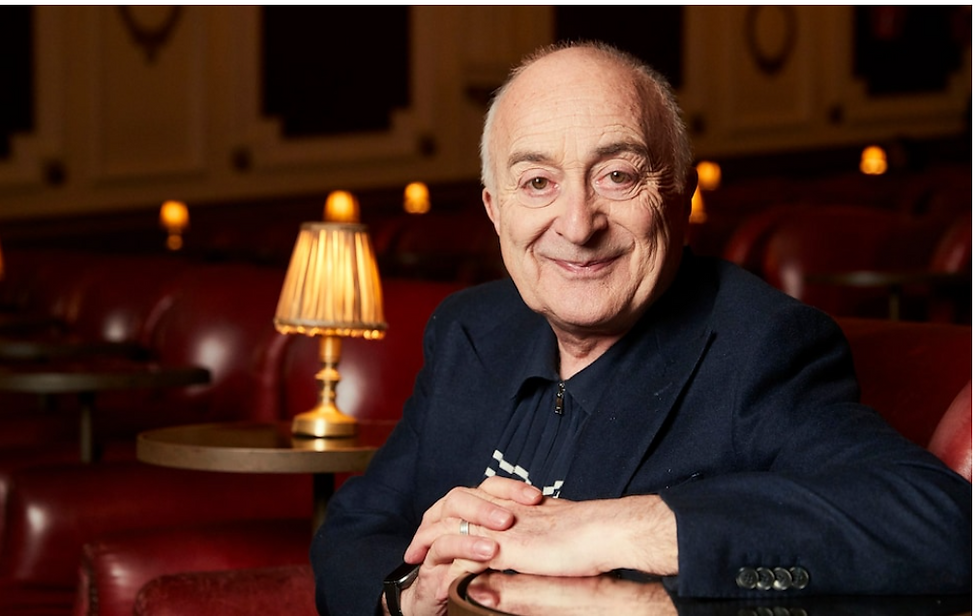
Only the most loyal fans of Rowan Atkinson or Richard Curtis would say that the first Blackadder series was much good. It had its moments – Peter Cook as Richard III – but featured a witless Edmund Blackadder who bore little resemblance to the swaggering character of later series. It was so different to what came later that Baldrick was really quite bright.
The curious thing about this is that the pilot episode was much closer to the Blackadder we know and love. It has never been shown on television until now. Blackadder: The Lost Pilot treated us to this original incarnation. Well done to UKTV channel Gold, who could have done the annoying thing – breaking the episode into clips, interspersing footage with celebrity talking heads – but instead did it right by broadcasting the half-hour pilot in full.
Before we got to that, Tony Robinson, aka Baldrick, provided the context and spoke to some of the people involved, including Curtis. Robinson had been cast in the pilot but was forced to drop out due to a scheduling clash with a play at the National Theatre. The role was taken by Philip Fox, who played it so differently that he didn’t seem like Baldrick at all. Although he did say: “I have a cunning plan…”
I’m still not quite sure after watching this why series one ended up the way it did, but the reason that series two became so much sharper seems to be down to the arrival of Ben Elton as co-writer. He saw instantly that Edmund needed to be clever and Baldrick needed to be stupid.
And so to the pilot. Like the second series, it was set in the Elizabethan era, and Edmund was the Machiavellian younger son of the queen (played by Elspet Gray). Robert Bathurst of Cold Feet fame was heir to the throne. It wasn’t riotously funny, but there were seeds of a good show in there and a fun cameo from Alex Norton as a lusty Scottish warrior.
Robinson guided the programme with warmth and affection. Curtis cheerfully admitted that it was a piece of work “about which I have no memories at all”. The show highlighted such joys as Howard Goodall’s lyrics to the theme song: “The sound of hoofbeats ‘cross the glade/Good folk, lock up your son and daughter/Beware the deadly flashing blade/Unless you want to end up shorter…” The only omission was any reference to Miranda Richardson. As the Queen in series two, her brilliant performance was surely a major factor in the show’s success.

Blackadder, the Lost Pilot
UKTV Channel Gold
★★★★
The Complex Journey To Air Blackadder’s Pilot Episodes
by writer and producer Owen Braben

Working in the world of Blackadder is never straightforward. It’s a huge show. The rights structure is complicated. And it doesn’t feel like I’m betraying any great confidences when I say the relationships can, on occasion, be complex too.
So, against that backdrop, how exactly do you go about licensing a 40-year-old pilot that’s never been aired before?
The answer is: with extraordinary difficulty!
First, we had to convince the format holders – Rowan, Richard, Ben, and John – to buy into what we wanted to do. Which wasn’t always the easiest needle to thread.
Over the course of a few months, I variously harassed everyone and promised to take a lot of people to fancy lunches at the River Cafe if they’d consider the idea. Eventually, very sweetly, everyone said yes. I think mostly so I’d stop ringing.
And then there was the small matter of the nuts and bolts of a deal with Marc Berlin, the man who’s in charge of Blackadder rights package. Marc’s been around forever and is (quite rightly) very protective of Blackadder. Again, tricky. But we got there. I think I might have mentioned lunch at the River Café again. I forget.
So, by early 2023, we had, I thought, all of our ducks in a row. The Blackadder format holders were happy. Gold were content. I think I’d even written a script, which was rather bold of me, and doubtless tempted fate.
Because there was, we learned, still a rather large fly in our ointment.
Did the BBC ever actually clear the pilot for TX? What was in the contracts the actors signed way back in June 1982? Was there even a paper trail we could follow to make the licensing work? Nobody was quite sure. The Beeb had to spend weeks on end going through old cardboard boxes, trying to find the original paperwork.
Time ticked on. Deadlines came and went. The River Café wasn’t going to be able to help me here.
The answer came (as it so often does) from Rowan’s agent, Peter Bennett-Jones. Even though the Adder pilot had been made when Rowan was represented by someone else, PBJ had been able to find a copy of Rowan’s BBC contract from 1982. And it was a TX contract. So if Row’s was, then it followed everyone’s would be.
We now knew we absolutely, definitely, could license the pilot. The BBC were happy. Gold were happy. Alas, no more lounging at lunch at the River Café for me. It was time to do some actual work. We were on!

Brian Cox: How the Other Half Live
Channel 5
★★★★
How the Other Half Live review — Brian Cox’s fury puts Logan Roy in the shade

Brian Cox’s outburst midway through How the Other Half Live had a scary ferocity to it worthy of the billionaire Logan Roy in Succession. “This stuff is f***ing painful. And it’s constantly f***ing painful,” he said, spitting the words and turning on his documentary crew. Logan Roy would never become this enraged and distressed over poverty-stricken mothers struggling to feed their children. Cox, who plays Roy, however, was livid, his outrage palpable on the screen.
You don’t get this sort of fierce honesty in the beige celebrity travelogues we’re constantly fed and it was refreshing. He questioned whether making this documentary was itself “mercenary”, a man who grew up in penury in Dundee after his father died when Cox was eight, which seems to have left him with a sort of fiscal PTSD. The director, sounding a bit nervous, said that they were merely documenting the extremes of the wealth gap. Cox has no interest in money, he said, but it remains his “demon”.
It was an excellent film made even better by Cox’s patent lack of interest in the ostentatious houses he looked around, his disgust at the statistics he read out — such as “during the pandemic the ten richest people on the planet more than doubled their wealth” — and his anger in Miami, where immigrant workers who are the city’s cleaners and car-washers are being turfed out of their affordable homes so they can be “redeveloped”, probably into more luxury pads for the rich. America, with its lack of a welfare system, was “f***ed”, he said. “This country has to get its shit together.” Succession is so brilliant that I didn’t think Cox could rise any higher in my estimation. He just has.
The Vicar Of Dibley: Inside Out
Gold
★★★★
![Vicar].jpg](https://static.wixstatic.com/media/c5709e_e943bedda99f4f59a6263f7c875ca635~mv2.jpg/v1/crop/x_0,y_0,w_560,h_242/fill/w_560,h_242,al_c,q_80,enc_auto/Vicar%5D.jpg)
An affectionate stroll down memory lane, as Dawn French and Richard Curtis choose their favourite moments from one of the UK’s best-loved sitcoms and talk about the making of the show. They’ll be joined by a selection of celebrity fans including Kylie Minogue and Joanna Lumley.